18 December 2017

You CAN Buy Gas In Bolivia (and the facts about the rest of the country, too)

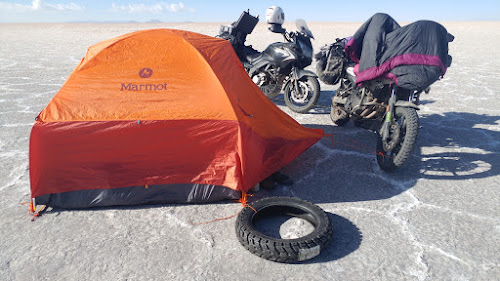
The Salar de Uyuni--a truly unique experience to ride on!

I sat in the audience burning up, trying not to cough, surreptitiously swiping at my ever-leaking nose, being terrified about what I was hearing. With the temperatures at the BMWMOA Rally in Salt Lake City, UT topping out at about 104F everyday, and my own just slightly lower, I thought the best use of my afternoon would be to attend a session about traveling through Central and South America. Sitting in the cool, air-conditioned room, getting valuable information pertaining to the trip I was about to embark on seemed like a damn fine idea, but as I listened, I grew a bit more frightened by what I was hearing.

The one hour session that afternoon was being led by a man from Texas, with a thick southern drawl, who had not only recently done the trip, but had also published a book. It was clear early on that our travel sensibilities were different. He pretty clearly was new to the GS world, and when someone told him to ditch his camping equipment because it made his bike too heavy and he would never use it, he promptly did. But as I listened more, and he talked about countries further and further south, I internally debated whether the AC in the building balanced my growing distrust for his travel style.

Then, he got to Bolivia.

And I sat up, listening carefully, and I suddenly became very nervous. The presenter spoke of how he had ridden into Bolivia with a friend he had made along the way. His friend was Australian, and boy was he glad he had an Aussie friend. He quickly found he couldn't buy gas in Bolivia because he was American. He talked about how Bolivia requires a gas station attendant to input your license plate into a computer, then choose your country prior to dispensing fuel. He stood with the first attendant searching for the United States in the list of countries "permitted" to purchase gas, and found it was not there.

For the rest of his gas purchases in Bolivia, they would use his friend's license plate and country of origin, and he would just pay the Aussie back after fueling up. Eventually, in a country other than Bolivia, the two parted, and the Texan continued on his way.

I know very little of the rest of his story, as I had stopped listening, and was focusing on my coming problem. What do you mean I can't buy gasoline in Bolivia? I'm going to Bolivia, how do I get through the country? Do I need an Australian friend? How do I find an Australian friend? Is there a Facebook page for that, or maybe a meet-up group? Can I put up a search on ADVRider--"Wanted, one Australian friend for about a week in the country of Boliiva! Me: I like long walks on the salt flats and 220 Km rides through sand and dirt. You: Must have Aussie-plated bike and good sense of humor."

That rally was in July. Five months later, we find ourselves getting ready to cross the border from Peru into Bolivia. This thought has weighed more and more heavily on my mind as the time has grown nearer. A couple of nights before we cross, I PM a Facebook aquaintance who has recently gone through Bolivia, and ask him what the deal really is. He reassures me, saying its a bit of a process, but not to worry--I'll be fine.

At my insistence, we top off fuel at the Peruvian border town. Despite the hoops Americans have to jump through, and the money we have to dish out to get a visa to get into Bolivia, the border process was a breeze. The immigration and Aduana officials were very nice and we came prepared--we were through all of it in half an hour.

Then, it was on to La Paz. One thing Mr. Texas had talked about were the horrors of the traffic in Lima, Peru. After hearing this from one or two others, we were prepared for it, though I was surprised as we made our way through the city at rush hour time that it wasn't as bad as I was expecting. However, now we're in La Paz, and I'm pretty sure I'm going to be run over by one of the bazillion collectivo or taxi drivers. Traffic was worse there than any city we had yet seen. How did you miss that one, Mr. Texas?

We stayed the night, paying about $15US for a hotel room, and just under $3US for dinner. The next day we motored to the southern part of the city where we found Flor de Leche--a dairy that makes magnificent cheeses. We ate cheese and bread, then headed south.

Ah. May. Zing. Cheeses.

I knew, at some point that day, we would have to buy gas...

Right outside of the city, we pulled off the highway, and headed into the gas station, my stomach in knots. As I rolled to a stop and pulled off my helmet, the attendant walked out to us. He promptly told me the foreigners' price per liter, we chatted a little, he filled the tanks, we payed, and we were on our way.

And I heaved a HUGE sigh of relief.

So, what's the real story? It sure as hell is not that "Americans can't buy gas in Bolivia." After being reassured by Chris on the Facebook, I attempted some research. In a nutshell, this is what I found...

Bolivia has heavily subsidized gas for Bolivianos. I don't know why as I didn't bother to get that deep into it, though I would guess it has to do with poverty levels and massive distances some people have to travel as the country is so scarcely populated outside of La Paz. Anyway, years ago, many providences (this is not a correct term, but I'm using it for demonstrative purposes) which bordered neighboring countries, and also ones further inland, refused to sell to foreigners to keep people from those other countries from border-hopping to buy cheap gas.

This was not good for tourism. Bolivia is one of the least-visited countries is South America, and this didn't help them in that area. So, Bolivia created a second rate to charge fuel at, for non-Bolivianos. This worked well for the most part, but some places would still refuse to sell to foreigners. Let's be honest--many people who travel through the country via land, whether they are over landers or tour companies from Chile or Argentina, are driving at least SUVs, and often much larger rigs. They suck up a lot of local gas.

However, in 2011, Bolivia actually passed a law stating that ALL areas of the country must sell gas to foreigners. Bolivianos get the subsidized rate--right now about 3.50BOB/liter--and foreigners of ANY country get a higher rate--about 8.67BOB/liter. For reference: $1USD=$6.80BOB and approximately 4 liters=gallon.

Gas stations can simply fill up a Boliviano's tank, and the pump will read the correct price. For foreigners, the attendant must record the license plate and country of origin, pump the gas, and calculate the correct price, often on a calculator. At larger, brand-named stations, they are fancy enough that the pump will switch to the foreigners' rate. Now, all that said, there is one other rate that although not entirely on the up and up, is pretty widely available. This is referred to as "sin factura."

At the smaller stations, the "sin factura" rate comes into play. Savvy attendants know drivers don't want to pay more than $1.25US/liter. They also know that, if there are no cameras around, they can pretend it's a Boliviano filling up, while pocketing the rest. But, drivers know what the rates are, and that an attendant might like to take a little home. So, it becomes a bargaining tool. Now I would never be part of something like this, but I can illustrate how it works. I shall use a motorbike rider named...Leslie. It goes kind of like this:

Leslie (pulling up at the pump, whipping her helmet off and flipping her hair, while smiling her flashy grin): Hola. Buenas tardes!

Him (caught a little off guard--oh crap, it's a girl...): Buenas! Es $8.67 por litro.

Her:...y sin factura?

Him (smiling): $7

Her (giving a little snort of laughter): $5

Him (holding up six fingers and smiling more): $6

Her: Esta bien. Llena, por favor.

Leslie winds up paying more than a Boliviano, but considerably less than the foreigner price. He winds up taking a bit extra home. The entity screwed is the government as they don't end up being able to charge the gas station the extra taxes the foreigners "should have" paid.

An American--and anyone else for that matter CAN buy gasoline. This is not to say there aren't places that might refuse to sell to you. That happened in Oruro, and had I been interested in bullying the attendant and citing the law until I broke him down, I could have bought gas. But, there were other gas stations, and someone would happily sell me gas. Movin' right along...

So, with gas not really being an issue--and apparently anyone spouting anything can publish a book and author a session at the BMW Motorcycle Ownwers of America Rally--there is one issue moto travelers should be aware of in Bolivia.

There is a very specific speed trap on the Pan-American Highway that, by all accounts, seems to be aimed at foreign moto-travelers. I had read a report of the speed trap on the iOverlander app, and knew to look for it. Someone had been traveling at 115 K/hr when he was pulled over for exceeding the speed limit of 100 K/hr. It took a lot of smooth-talking it sounds like, but he managed his way out of a speeding ticket--or something else--by finally showing the cop his broken speedometer cable.

This particular speed trap is crafty, because there is not only one station of cops with radar guns--in a very obvious spot where you can see them for miles--but because of the second part of it just over a rise from the first. Once you get over the rise and start heading downhill, the cops are waiting there with the radar gun pointed right at you. Locals know about it. They slow down for the two kilometers of dealing with the cops where the speed limit is not 100 but 80 K/hr. That is about 50 Mph on a 4 lane, divided highway...completely stupid.

Now, it's not like we would be speeding through this area, but let's refer back to what Leslie and her riding partner may have encountered at this speed trap. Leslie and Partner slowed down to the speed limit, with all the other traffic, as they approached the speed trap. Being unaware of the second set of cops, they may have sped back up to get up the hill, then as they crested it, came down the other side slightly over the speed limit.

Boom.

Cops standing in the median waving Leslie and Partner to stop at the side of the road where an unmarked station wagon sat at a small intersection. Leslie, being the woman and not leading, would be completely ignored. Partner would be told to put down his kickstand, and go with the officers. The Partner would do so, grabbing his passport and Aduana papers--most likely, Partner speaks no Spanish.

But, no Spanish is needed, and really, neither was the paperwork. Officers never ask for paperwork, they only threaten Partner with a huge ticket--one huge ticket because Leslie was just following.... After threatening the huge ticket and the round-trip to the bank to pay said ticket, Officer number 1 would send younger, less-experienced Officer number 2 to continue to man radar gun, and would quietly tell Partner to follow him to the beige-grey car, telling him he could probably just give the officer a couple hundred Bolivianos and forget the whole thing.

And Partner does.

He gets back to the bike, stows the paperwork, and he and Leslie ride off, while he recounts the story in their helmets.

And Leslie fumes.

She knew the speed trap was coming. She also knows that of all the reports she's seen of this one, it is only ever foreign motorcycles who get pulled over. Leslie knows she was speeding, and has no problem saying what she did was wrong, but she also realizes those cops are nothing but self-serving liars. That money would never go to the police, to funding a force to make things better in that country. She knew Officer number 1 would take 75-100% of it, while telling Officer number 2 he had gotten way less or nothing. Officer number 1 and his wife would have a fancy dinner. It's not much different from gas station attendant....

Oh well, such is the way of life in other countries. I have no doubt we have our share of dirty cops in my home country, but if I ever encounter one, you can bet I will punch him/her in the nuts. There is no reason to prey on foreigners. Take the damn tourism money and be glad others are spending in your country!

Our first stop in Bolivia. YAY! Bolivia!

So, there are the two bad possibilities of Bolivia. But, really, that is it. Beyond gas and speed traps, the country is amazing. It is full of wonderful people, beautiful scenery, and a mind-boggling number of llamas and vicuñas.

Llamas, as far as the eye can see. And a few sheep, too.

Bolivia can feel tiny when you're in one of the small towns, wandering at sunset with the town's residents. Bolivia can feel immense and isolated when you're in the middle of the Salar de Uyuni, with no one else in sight for hours. The long 220K stretch of dirt (sand road) that stretches to a quiet, lonely border crossing into Chile can send you back in time, believing that the scenery and the primitive road could not possibly come from the 21st century, nor could the wooden boats used to ferry vehicles across the strait of Titicaca.

None--NONE--of those wooden planks are fixed. They just lie there and you hope they stay in place as you ride onto them. The bus was not as lucky as we were...
None of the wooden planks on the boat are fixed. Don't put a foot in the wrong place...

Gawd, I loved Bolivia. I can't wait to go back. But, it's kind of like my favorite Mexican restaurant. I want to go back and experience the rest of it, but what I've already encountered has been so good, I want to go see that again! How do I choose? I guess I'll find out in early 2018 when I return.

This is Tomás! We are seriously family now--he's awesome!
Someone wanted a haircut...on the Salar.
It was so windy on the Salar, and it was impossible to stake into the salt crust. So, we tied the tent to everything...
We even had the monument to ourselves
This girl wanted to sit on my bike! It was great!
Getting the salt from the Salar de Uyuni washed off!
Josh and Pedro--we had dinner and then breakfast at Pedro's alojamiento in Alota. Warm and kind people everywhere we went!
Our final night in Alota, Bolivia at some un-named hotel-like place.


04 December 2017

When The Introvert Speaks Your Language

Do you speak a language other than the one you grew up with? Did you learn it in school--maybe high school or college--or as an adult? Did you learn, or attempt to learn, another language in order to travel?

It's hard. No joke, it's really hard to learn a foreign language when you're not a child.

I often joke about my "shitty California public school education." But, one area of learning that was handled well when I was in high school--meaning, I was challenged, much was expected of me, therefor I stepped up--was my Spanish classes. My teacher was named Mrs. Sands, and should you pass her on the street, you would not assume she could speak Spanish fluently.

Mrs. Sands was kind of a hard-ass in her first-year Spanish class. She'd stride across the class room a short, somewhat round fireball of a woman, fluffing the back of her short, curly hair as she conjugated verbs, or asked a student what something meant. As one of her students, you didn't screw around, you didn't not do your homework, and you didn't fail to participate. She would not hesitate to call you out on that shit. If you did what she expected of you, she recognized it quietly.

If you didn't fail her class, or melt under her expectations, her second year of class lightened up a bit. She expected just as much, but she was quicker with her smiles, and even cracked jokes on occasion. Suddenly, you thought, "Hey, this Spanish stuff is kind of fun. And what the hell, I might actually use it one day, unlike, say trigonometry...."

Very few took a third year of class from her. The first two years satisfied a curriculum requirement, and most parents' expectations. But, the third year of class was basically a Spanish Lit. class. Reading literature and continuing with Spanish? Yes, please. Especially if I could take that instead of a fourth year of science classes....

So, here I am, twenty-five years after graduating from high school, and drawing on everything I can remember from those years. About a month before we left on this trip, I started Duolingo for a little bit every night, just to refresh the basics. Josh had started doing it a couple of months before that, and I whizzed past him in no time. I highly recommend this fun app.

So, let's talk about Josh. He took a French class ages ago. That's about it.

A couple of years before we were to leave on this trip, his parents bought him the Rosetta Stone Spanish learning kit. It is supposed to be the best, and the easiest, way to learn a foreign language. He tried, and I mean he tried hard. He'd spend an hour to an hour and a half, several times a week, sitting at the computer, head phones on, learning as best as he could.

But, just like not everyone is made to learn trigonometry, not everyone is made to learn languages. It just didn't sink in.

Now, here we are, on a trip to a whole bunch of different countries, all of which use Spanish as a common language. And only one of us speaks--and I'm using that term quite liberally--this language.

And the super shitty kicker--I don't want to talk to anyone because I'm an introvert! It's not that I don't like people, (although, sometimes I just don't like people...) it just takes a phenomenal amount of energy and a quick pep talk to my confidence to engage someone in a conversation when I don't know them. And other than Josh, I don't know anyone.

Also, I "learned" this language more than 25 years ago! I don't remember that much. I have very little confidence in my performance capabilities.

At the beginning of the trip, we would be riding somewhere in Mexico and Josh would see a word, or a whole sign full of words, and ask me what they meant. I pretty much knew anything like that. I mean, it's not that hard to figure shit out when you can take a moment to read it and put it in to context. One day he asked me what something meant and I told him, and he said, "Wow, you know a lot of words." The funny thing was that I had just been congratulating myself on things I remembered, that I hadn't thought of in so long. I knew so many words!

But, there were SO MANY MORE I didn't know, and conversations were a whole different matter. Thankfully, one thing I am really good at asking someone is to repeat what they said, but more slowly. Sometimes it works, sometimes not.

And then there is the situation where someone says something to me, I unsderstand and answer back, and that person thinks, "Oh good, she speaks Spanish!" And continues on at a rapid-fire speed. Then, I just stand there, eyes like a deer in the headlights, mouth slightly agape, mentally grabbing at any word that sounds familiar, and trying to make sense of what they're saying.

Sometimes, it's not so bad. At the Guatemala/Honduras border, a young man directed us where to park, asked a couple of questions, and directed us where to go, what to do, and in what order. He was very friendly and also asked a few questions about the trip. I sailed through that conversation with little trouble--smiling the whole time--then thanked him for speaking slowly enough for me to understand. He smiled hugely, then said that he also spoke clearly, unlike a lot of other people we would meet. He wasn't wrong.

There was that one time. At that one cigar factory.

So, this is how a lot of things go. Josh decides he wants to do something or go somewhere, gets things set up or gets us somewhere, then says, "Okay, go talk to that guy and ask him...."

All the time. This happens all the time.

But, more specifically, it happened when we were in southern Honduras. Josh emailed a guy he had met at a cigar convention, and said we would be in Danli, was there any chance we could get a tour. He said absolutely and put Josh in touch with Maritza who was then public face for that kind of thing, at that specific factory. She and Josh corresponded, and set up a date and time, and when that date and time came, we showed up that the factory gates.

Twenty minutes, 15 kilometers, and three sets of gates later, I walk up to a guard, explain why we're there, and am met with a long string of words of which I understood exactly zero. I explained that I know little Spanish, could he please repeat what he said, only more slowly. Then he did, and I still didn't understand a single word. But, this time I understood why didn't understand anything.

He stuttered.

Oh gawd, that just about did me in. But, he was patient and kind, and I worked really hard, and we got it all figured out.

By the way, if you're wondering, Maritza had decided to go home an hour earlier than our scheduled appointment that day. The bitch stood us up, and I had to TAX THE SHIT out of my brain for nothing!

Aside from speaking really quickly or not clearly, there is one other thing that seriously trips me up. Every country has its own dialect. It's not too difficult, and people can usually understand what I say. It just sometimes takes me a bit to figure out what word I need to use when I ask for something, and they look at me like I have two heads.

Seriously. I get this look a lot...

Of course, I think, "I know what I said is correct! I just used that word for two weeks in the last place!"

Peru has been the worst. It's been so hard because Every. Effing. Word. Is different. So, once I get a conversation figured out with someone, I usually turn on a bright smile, tilt my head to the side, and say something like, "So, you used the word -----? In other countries they use -----. There are so many different words used in different places, I have to learn new ones all the time!"

And, I say all that in Spanish because I'm a badass.

So, if you're traveling this way, here are different words for different things--things we need a lot!

The first you should know, if you are traveling over land south of the United States (of Norteamerica, as they will tell you in South America) is...

SPEED BUMP. They are known as topes, tumulos, resaltos, muros, gibas, and who knows how many other words my iPad would like to autocorrect. Oh, of course, my most favorite: in Panama, I asked our cab driver what they were called there, and he answered "policía muerto." I laughed so hard, and then he told me they called the big ones "General Muerto." That made me laugh even harder, which just tickled him.

Anyway, why are these words important to know? How about driving/riding over more than 180 of them in ONE DAY? You might round a bend at 90 Km/h, and find a pueblo (poblada, ciudad), with speed bump after speed bump in your way, and nothing of warning they're coming, but a sign with that word on it. Also, if you're a non-Spanish speaker riding with a Spanish speaker, and trying to warn her one (or 14...) are coming up, you should learn to pronounce them correctly. Otherwise, you'll be likely to have a conversation like this.

Him: Slow down, tamale.

Her: shaking her head, slowing down.

Him: More tamales.

Her: STOP CALLING THEM TAMALES!!! They're *TUMULOS* not tamales! Tamales are warm and delicious and would squish if you rode over one. Tumulos are NONE of those things!

Him: ...tumulo...

But seriously, I counted them one day as we rode. It was not a very long day of riding. In fact, it was fairly short mileage-wise, but I lost count at 183 that day. I do not hesitate to say we rode over more than 1000 topes in Mexico.

Here are a few more. I highly recommend the app SpanishDict, as you can type most of the below words in to figure out what they mean. You cannot necessarily type in the English word and get all the translations, but if you're confused about a Spanish word in front of you, it is a very comprehensive dictionary. Do not use the EnglishSpanish Translator app. It blows.

STORE: abarrote, tienda, pulpería, mercado, bodega,

RESTAURANT: lonchería, restaurante, comedor, fonda, soda, cafetería, parillada, parador, paradero

HOTEL: hotel, hostel, hostal, hospedaje, hostería, posada, alojamiento

PASS (as in passing a car on the road): pasar, rebasar, adelantar--these are good to know. There are often signs telling you where you are not allowed to pass another car. You know, like over a double yellow line directly in front of a cop... Also, please note that no one, in any of these countries, really pays attention to this rule.

PARKING (good to know when asking if a hospedaje has secure parking for your motorbike): estacionamiento, parqueo, cochera (though I'm pretty sure only Peru uses cochera, and it's just so they can make you feel stupid when you ask for parqueo)

These are just a few examples. There really are SO MANY WORDS. I used to get absolutely sick to my stomach when we were coming up to a military/police checkpoint, or on days when we had to do border crossings. Now, at three months and something like ten countries in, it's much less of a big deal. Having fun conversations with strangers, and sometimes other travelers, becomes a bit easier everyday. Each time I come away from one smiling, feeling a big boost to my confidence.

I think about Mrs. Sands just about everyday of this trip. She was pretty great--¡Genial!--and I'm grateful to her for making those classes fun.


12 November 2017

Moto Traveler--a day in the life...

What does a typical day in my life as a moto-traveler look like? Someone recently asked me that, and all I could think was, "Hah! Not like the next day, or like the day before!" Every day is so different to me, depending on where I am traveling, what kinds of roads I am on, who I meet, and most importantly, WHAT I EAT!

But, I really appreciate the writer's question, and I'm going to try and answer it as best I can in one post.

Here is Stan's question--

"...tell us all about a day in the life of Louise the Adventure Rider - meals - laundry - showers - safety - and what is this insurance you speak of????"

To start with, we have spent 39 days tent camping, and 31 days hostel/hotel/boat.

MEALS

Meals are a good place to start, since one typically starts the day. In my normal, everyday life, coffee starts the day. I am not typically up for a meal. There is something about my body that, unless it is a Sunday, absolutely revolts at the idea of eating real food most mornings.

Camp cooking!

But, things are different on the road. Riding a motorcycle, whether on-road or off, demands physical as well as mental efforts. If we are camping, we usually start the day with coffee, oatmeal, and hopefully a banana we picked up the night before. Before we left Denver, we had a large package of Krusteaz pancake mix. The night before we left, it was suggested we could just pour some into a ziplock, then we would have it if we wanted it. Josh was completely uninterested in the is idea, but the first morning he, Doug, and I woke up in the Grand Canyon, and I mashed a banana to make banana pancakes for breakfast, his mind changed! Occasionally I buy a couple of eggs and make them to go with.

If we are staying in a hotel--we just stayed in one in Colombia for about $10US--we might eat breakfast in their restaurant, or seek out a panaderia (bakery) for breakfast. The Central American typical breakfast usually includes an egg or two, beans, a small slab of cheese, and tortillas. It's usually delicious and filling, and I love it. In Guatemala, you get refried black beans that are to die for!

Pasteles tamales in Colombia. When the server said tamales, Josh ordered two based on what we know of tamales. Pro tip: only order one of something when you are new to a place. You can always order a second if it's not enough, but it might be e size of your head!

Lunch depends on where we are in the course of the day. If we're in the middle of nowhere, we eat off the food stores we carry--typically crackers, tuna, cheese (yes, we carry cheese over multiple hot days. It's fine) fruit, peanut butter. If we're riding pavement and rolling through small towns regularly, we stop at a shop/shack/restaurant on the side of the road, and eat whatever they happen to be making. It is always delicious, always, inexpensive, and the people who make the food make it as though they are cooking for their own families. These have been some of our most delicious meals!

Typical Costa Rica lunch for about $6US total.
All the bakery goodies!

We have cooked a lot of our own dinners. They are typically foods we've picked up at local stores, sometimes mixed with things we've brought along. I brought a few staples I thought could easily be combined with fresh veggies and meat, such as quinoa (we had a sizeable bag of that left in Denver) and some pasta. For all the food we cook, we have a MSR Dragonfly stove, a 9" non-stick frying pan (handle cut off to pack more easily), a Sea to Summit collapsible silicone 3 quart pot, and various utensils.

LAUNDRY

I have to laugh at this. We smell. There is no way to get around that. Everything has been wet for a month and a half--yay, humid jungle--and has a slight mildewy smell. I find laundry to be somewhat difficult, and often not worth my time...I've got riding and sight-seeing to do! But, it does get done in various ways.

1--Drain stop in the bathroom sink in a hotel or hostel. Anyone traveling outside of the U.S. should buy a simple flat, rubber drain stop. Few sinks have stoppers, and a sink is always big enough to hand wash some undies or t-shirts in. We carry Dr. Bronners soap for all the washing up--it rinses easily and is safe anywhere you are.

2--Dry bag method. For slightly larger pieces, or wanting to wash a number of things in one go without access to a washing machine. We half fill a 30 liter Sealine PVC dry bag with water, add a few drops of soap and some clothes, roll it closed, and then take turns "agitating" it by shaking and tossing it around. We then empty it, squeeze out the excess, refill with clean water, and repeat. This is basically how our washing machine works, and it does a okay job.

3--Washing machine. We have stayed a few places that have a washer we have been allowed to use. There is never a dryer, but always more than enough lines to hang-dry everything. We are currently using that method here in the mountains above Medellin, Colombia, drying things in the open when it isn't raining.

4--Lavanderia. We have been in a few cities that were large enough to have lavanderias. This is typically a home where you drop your laundry off for the day, and it comes back washed, dried, and folded. It is actually dried in a drier, so some of the wool stuff has shrunk a bit, but it's been worth it. Dumping out the fresh load of clean laundry to divvy up into our own bags always seems sooooooo marvelous!

SHOWERS

Amazingly enough, almost everywhere we have stayed have had showers, including all but maybe two or three camping places. My rough estimation would be that about 75% of them have been cold, or roughly ambient air temp. Some places have had shower head water heaters that work-ish. I get pretty excited at a hot shower, though in Panama City, I burned myself. Sometimes the water drains well, sometimes not. I have definitely worn shoes in a lot of my showers. A lot of the showers have been outdoor, or partially outdoor. In the end, when I get out and feel clean, especially after a hard, hot day of riding, I'm just thankful to have had one!

SAFETY

So, this is kind of a big one, with a lot of angles to tackle. First and foremost, we do not carry a firearm, and never have on a trip. This is a big controversial subject within the adventure riding world, but I do not, and will not, attempt to carry a firearm across international borders. I don't do it on trips in the states, so I am not going to risk being caught with one in another country where I am not allowed to have one. As one friend mentioned to me before I left, "The bill of rights doesn't go with you into other countries."

We choose to travel smartly. No riding at night. It seems like a no brainier, but, we have broken that rule two different times. Both times, however, we knew where we were headed for the night, and just had to finish out the riding day after a border had taken longer than we expected. Besides the obvious reason of being vulnerable on a motorbike at night when people may be up to no good, many of the roads we have ridden have been riddled with potholes, large enough and deep enough to swallow a F700GS with me on it. No, thank you.

We are traveling with soft luggage, unlike most people who do this trip. I had my reasons for wanting this luggage, and it had proven to be wonderful. We have locking straps with airline cable for each piece, which have doubled as bike/wheel locks when we've left the bikes in a place we weren't ABSOLUTELY sure about.

We have never felt unsafe. We have never felt threatened. That isn't to say danger and threats aren't out there. We met a couple on the Stahlratte crossing from Panama to Cartegena, who had been attacked and robbed in Guatemala. They had no bodily harm done to them, but they were threatened with machetes and guns by masked men. Their tank bags were stolen with some bank cards and personal items. We carry fake wallets with photo-copied and laminated driver's license copies, fake credit cards, and a dollar or two. Real stuff is locked away. I'd be sad to lose my tank bag, but the trip wouldn't be crippled.

I briefly looked over the U.S. State department's warnings about traveling through Mexico, because something like 15 people sent me the link. I then only avoided the area of Mexico our Mexican neighbor told us he would avoid. The iOverlander app has a red warning symbol where people can report bad things that have happened to them on the road. I usually read these over in the area to which we are going, just to be prepared, but we haven't run into much more than a few kids with strings across the road, looking for money for something or other. They usually drop the lines as we get close and they see we are foreigners on big bikes. When they are holding buckets for school/community fundraisers, I always drop something in if I have it.

INSURANCE

This question comes on the heels of a mad and frantic search for insurance in Colombia by 17 of 21 riders on the boat. For the most part, once you leave the U.S., your insurance is no longer valid, with the exception of Mexico. In Mexico, you need to have Mexican insurance in addition to your own. Some countries have no requirements for it, while some require you to buy insurance as soon as you enter the country,

Colombia requires that visitors purchase insurance if they bring a while into the country. It is referred to as liability, but it basically covers third parties injured or killed in an accident. There has been some abuse of the requirements, and the government has been cracking down by changing procedures the individual insurance companies have to go through. We spent two full days in Cartegena and then another half day or so in Medellin trying to get it. We visited eight different offices.

It. Was. A. Pain.

In the end, we spent Tuesday through Friday riding the bikes through Colombia without insurance, which is fairly risky. The fine is upwards of $200US if you are found to not have it. Also, the drivers here are the worst we have encountered on the trip. I felt very relieved to get it, as I know the others on the boat did as they, little by little, were able to acquire it.

It seems ridiculous, but the search exhausted me. A lot of the time spent was spent waiting to see if it would happen. It was stressful. People in the offices speaking to me in rapid-fire Spanish to explain what was needed, or why we were waiting, or why things couldn't be handled taxed my poor little brain. At the end of these days, I felt like I had failed culturally, and just wanted to go to bed at 7. It was also especially annoying because it was all to have been taken care of by the ship's agent--we paid a pretty good premium to have had that done. Then, not only was it not done, but I was unprepared to handle it because I thought it would be done. I didn't research anything--good offices, what was needed, what goes into a certain box on the form when you ride a F700GS and your bike is not in the system (the damn system!!!).

But, as of yesterday, it is done. We have insurance, and I am better prepared for how to deal with it when we return.

Want to know more? Is there something I didn't answer enough? Please ask. You can always comment here, shoot me an email. Or post on my FB page. Sometimes it's nice to have a goal when writing this blog, other than just talking about the motos or the places. Not everyone gets to travel this way, so I am happy to talk about how I (we) do it. I also know there are people who are wanting to do a trip like this, and trying to collect as much info as possible. I will share anything I know, I just don't always know what someone is curious about. Ask away! This trip is amazing, and I am happy to share!


23 October 2017

Coffee Please!

Many people know Guatemala is a coffee producing country, but there is something special about really being able to see where the stuff you love comes from. After Chichicastenango, we headed to Antigua. It had sort of been on our list of places to go, but we could skip it if we were pressed for time. One of the big draws for us was La Azotea Coffee Plantation and museums.

A few days prior to our arriving in Chichi, the GPS gave up the ghost. Much time was spent pulling it apart, buying a multimeter to see where and how power was or was not getting to it, and pronouncing it officially dead. While in Chichi, with good internet, Josh got ahold of a rider and bought a new GPS of the same model. It was shipped to our neighbor's house in Denver, and they will be bringing it on their trip to Costa Rica, where we will meet them and pick it up.

So, all of that is to explain that we realized we had some extra days allotted to us. We didn't have to hurry through, so we headed to Antigua, and the Hostel Antigueno. Another stellar find, this hostel is run by Christian--an Antigueno who spent time growing up in California--and his wife, and we were allowed to camp in the hostel's lovely garden. We got there early in the day, got the tent set up, and headed off to the coffee plantation.

Josh practicing in the Mayan Museum of music. That museum and tour were a really lovely surprise.

We paid our entrance/tour fee, and walked in thinking we were going to wind up on a tour with a bus load of French tourists. As it turned out, they were just finishing their tour, and as we began ours, we were the only ones. The tour started in the museum of music--what, I thought we were here for coffee--with a lovely young Guatemalan girl who took us through the history of music, dance, celebration, and clothing of the Mayans of Guatemala.

Setup for a traditional Mayan market, which we had just gotten to see in Chichi.
This is a typical Mayan wedding. Women wear traditional Mayan clothing with a colonial Spanish veil.

At the end of that part of the tour, I went to ask her about what brides wear in Guatemala, and what the wedding ceremonies are like. As we were talking and she found out I was riding a motorcycle to Argentina, she got very excited, and said that was a dream of hers. She rides a motorcycle too! It was fun to talk to her about the gender gap in moto riding in Guatemala and the U.S., and fun to hear about her love of travel. I'm telling you, I have had the most fun in the most unexpected of places on this trip!

This girl right here! Maria Jose was so much fun to talk with, and maybe one day we'll get to ride together!

As soon as we were done chatting, Josh and I had to run back to the sampling room to start the coffee plantation portion of the tour. I learned A LOT about coffe growing and production, things I never knew about. One of the most interesting things I learned was that due to lack of money in Guatemala and advertising, Colombia took over the market as having the best coffee, because they had the dude with the burro in commercials. Remember in the 1980s, when one coffee company would advertise with Juan Valdez and his burro--100% Colombian coffee?

As the saying goes: Coffee should be black as night, strong as passion, sweet as love, and hot as hell. Word.

Well, it's not anymore. Those companies came to realize Guatemalan coffee was just as good (if not better, according to our perhaps heavily biased tour guide) and far cheaper to import than Colombian coffee. So, the importers import a mix, and now sell it as 100% shade-grown Arabica. (Which it is, though it's often implied it is also Colombian...)

After learning about the ins and outs of coffee production, we got to take a walk through the plantation. It was lush and beautiful, the coffee shaded by banana palms (which are making me banana-obsessed) and Ceiba trees. There was a ton of fruit on the small trees, and in a few spots they were turning red, signaling harvest time.

Coffee cherries getting ready to harvest.

I've always had an appreciation for coffee--like a large number of people I know--but like the chocolate, I enjoyed really getting to know where it comes from, who it affects and how it affects them, and where my money actually goes each time I buy or make a cup. Wait, who am I kidding? I don't make coffee--that's Josh's job....

Little ceramic tiles are set into the curb to let you know parking is reserved for motos! Love. This. Town.
One of these (giant) things is not like the others...

We got back to the center of town in time to drop the bike at motorbike-only parking--most blocks have curbs painted in white for motorbike parking, and a little ceramic tile with a pic of a moto on it--and head to the Chocolate Museum. Less of a museum and more of a business, it was none-the-less a great stop. We did get to learn about chocolate production on a larger level, and try everything they had in the store. I would up buying chocolate tea, which is the toasted husks of the cacao bean left over when the bean is removed for production. It is delicious, and according to the store, has many health benefits. I suppose the main one is that if I have a cup of that tea, I'm not drinking a beer...? Whatever. It tastes really good.

Antigua's arch in the twilight. The city was really lovely, and had a magical feel to it at this time of night.
Yes, that is a 30' light-up rosary hanging from the town's cathedral in Antigua.

We wandered the streets of Antigua--which is a really beautiful city with really heinous stone streets if you're riding a motorbike--had some dinner from street vendors in the plaza in front of the cathedral, and headed back to the hostel for a relaxing evening of game-playing.

Chutes and Ladders in Guatemala--where the "chutes" are snakes biting children. This is THE WORST version of this game ever!

The next morning, breakfast was included, and we sat at a table with a few other travelers sharing stories. Three of them were traveling next to Lanquin, and we found out that the day we had planned to go to Semuc Champey, the falls and all tours had been shut down for a time. Well, there you have it.

We left the hostel after reading border posts for the Honduran border crossing, and headed to an Office Depot to make copies we would need. Yep, Guatemala had Office Depots. Now you know.

Waiting in line, prior to knowing there was a special place for motos. A really nice local woman who was selling drinks or fruit to those waiting told us we should go to the front.
At the front, past the barriers. We were kilometers in front of where we had been in line, and eventually all the other motorbikers worked up the nerve to come talk to me and ask about the bikes. Then, when it was time, we all rode off together, leading the way across the kilometers-long construction area.

We spent that night about an hour from the border at a hotel/camp area called Las Laureles, and rode on to the Honduran border the next morning.

By all accounts, it would be a quick, easy border crossing, and for the most part it was. One mistake, we ended up there ready to do the last part--customs for the bikes into Nicaragua--at 12. So...we had to wait until 1, because they are the only office there where EVERYONE in the office takes lunch at the same time. Ok, note to self. Don't cross borders at lunch...

When we were finally done, we rode into Honduras (country number 3) and within 20 minutes or so, were in Copan Ruinas, the small city next to the Copan Ruins, the last of the Mayan ruins we would be visiting.


22 October 2017

Guatemala--Big Bikes on Badder Roads...

Tuk-tuks--not just for India. These are found everywhere in Central America, running people in town or even between towns in the mountains.

Following our amazing afternoon making chocolate, the skies continued to dump on us. While we were sleeping cozily in our hostel dorm, accompanied only by the dorms resident giant cockroach (he seemed harmless enough, but I chased him to the other side of the room anyway) the rain was no bother. Getting on the road later, it still wasn't an issue as we rode back towards Coban.

By the time we got back to the top of the dirt road that had taken us down to the river, things were in fact quite dry. I was leading and as we approached the turn off we had taken, I thought about the extremely sharp left turn we'd be making, across traffic, to head back. On the way down, it had been a very sharp right turn from a paved road to a dirt road heading immediately down hill, filled with loose rocks and ruts in the turn. I had made the choice to ride to the very large shoulder and turn off my ABS, before making a u-turn on the paved road and hitting the downhill loose stuff straight on. No problem, easy-peasy.

On the return trip, as I neared the top of our dirt road, I thought I would do the same in the opposite direction--ride straight up onto the shoulder, turn my ABS back on, then u-turn onto the paved road. As I crested the top of the road, however, I saw there was a large truck parked in the shoulder. I decided it was no biggie--there was very little traffic there, and I'd just make the turn.

As I got over the hump, onto the pavement, and well into the turn, I saw the one other piece of the equation I had forgotten. There were three potholes in the road. These aren't just little potholes, but giant motorcycle-eating potholes that probably drop bikes and riders all the way to China. At the last moment, I straightened my curve in order to ride the narrow 6" strip of road between two of them, realizing at the last moment I wouldn't have time or enough road to make the rest of the turn.

Since I had straightened up a bit, I figured I'd just stop, but as I did, my front wheel got far enough that it started to slide into the giant bike-eating gutter. My rear end slid around, and suddenly my bike was lying in the gutter, much to the horror of the men on the side of the road with the truck, and to Josh who was just getting up onto the pavement.

I was fine. We got the bike up, and other than bending the gear shifter (which we bent back), there was no damage. I just looked at Josh and said, "Leave it to me to not be able to figure out pavement..."

Moving on...

The start of 7W. As there are no road signs, I pulled up a mapping app to make sure we were going in the right direction.

Back through Coban we went, heading west. We knew we would be coming to a rough patch of road that day as we had seen a number of comments on iOverlander about 7W. As we got through town--after negotiating one-ways and all the turns one has to make to get through town since main roads don't just go through--the pavement ran out, and the dirt road began. We knew we had 27Km ahead of us of what had been labeled "terrible" road that you "shouldn't do."

We take everything with a grain of salt, as those reports are often made by people in bigger overland rigs, or Subarus with roof tents. Things tend to be a bit easier when you only have two wheels and you can bob and weave around holes, rocks, etc.

There was no bobbing and weaving.

The road was like Lacey Swiss cheese, only with more holes. Then, what was left of road was mud, because it was the raining season, and it had just rained for 24 hours straight. The only place there weren't holes, was where the road was a currently-running river, and we just rode the river path, or where a landslide covered the road.

And there were a lot of landslides. Most were easily negotiable (well, easily-enough), but one was huge. Half of the mountain side had come down, and was lying in a wet, muddy heap across the road. An enormous bulldozer was slowly moving sopping wet earth, and we sat and watched for a while. Unfortunately, one the side we stopped on, someone was also burning a huge pile of trash. It was a pretty bleak sight--mountainside gone, road gone, one lone piece of heavy machinery, and a pile on fire.

Josh couldn't take the stench of the fire anymore, and as the bulldozer moved to one side of the "road", he started down and across.

As he hit the really deep part, he said, "Oh, it's not that bad."

I said, "Really!?! Because you have both feet down as outriggers, and your rear end is fish tailing all over."

He repeatedly told me it wasn't bad, but I couldn't shake that image. I sat for a few more minutes as the bulldozer made another few passes, then gathered myself and headed down. Have I mentioned how much I hate mud? I really hate it. It's unpredictable and it makes your bike unpredictable, and throttling out of a bad situation can just wind you sideways when there is nothing solid for your tires to catch.

I did just fine. Through the first section.... But, I then reached the mound made by the bulldozer's blade constantly scraping, and I was running at an acute angle to it. As all the mud was the same color, it had been hard to spot earlier on, and as I approached it, I knew there was no way to go over it at a ninety-degree angle. I hit it instead at probably thirty degrees, and without enough speed. I went down on my left side in the slick, snotty mud.

Looking back at the landslide/fire, while covered (me and the bike) in mud.

I'm not gonna lie, I came up pretty pissed. I had been riding standing up, as that was the best way for me to control my 500+ lbs. of bike in the mud. I couldn't duck-walk my bike through like someone who had feet that touch the ground, I had to use better technique. Unfortunately, it wasn't enough. Josh came running back to help me get my bike up for the second time that day, and we got to the other side of the mess.

A smooth section of 7W...

We continued on. The road was terrible, but nothing more like the intensity of that landslide. Eventually, we rounded a bend, and magically, pavement reappeared. We had come to the end of 27Km of Hell. A very cool bridge with a steel deck lie in front of us, and though steel-deck bridges can make motorcycle riders extremely uneasy, after that road, it felt smoooooooooth.

Yaaaaassssss...

A few miles beyond that, and we reached Restaurant Rancho Don Canche. We had read about the spot as being a great place to stay for the night, and as we stripped off helmets and gloves, Don Canche came out to greet us. He is immediately everyone's friend, and he welcomed us to his restaurant, and asked us to please stay with him for the night.

Our new friend, formerly of Denver! Sometimes our world is a small place!

We said we would love to, but lunch and a beer first. It was late in the day, and there were a number of men there who were all friends, having Friday afternoon beers. We were immediately everyone's friends, and as the majority of them left that night, Don Canche told us how excited he was we were there, as he had lived in Denver for a few years.

One of Don Canche's friends quickly became our friend as well!
We rode the bikes in at night, and camped next to them.

We sat up into the night, talking with him, and I made friends very quickly with his pit bull/boxer mix, Campion. Campion watched over the place, but was also a big, 80 lb. mush of a lovey dog. When the last of the customers were gone, we moved the tables and chairs, and Don Canch insisted we set the tent up in the restaurant, and bring our bikes in as well.


My good buddy who just wanted to be where I was.
Campion, just chillin' in the morning.

As I was lying down in the tent, Campion came over to me, trying desperately to figure out how to come inside. I assumed he would probably head into the house to be with Don Canche, but I guess he decided I was good people, and he would look out for us. In the morning, I saw that one side of the tent was leaning in a bit, and as I looked out, I saw Campion curled up, lying against the side of the tent. Josh confirmed he had been there the whole night, lying on the dry bag that had been left outside.

Hey lady, quit looking at that map and pet me!

Eventually, after breakfast, we said good-bye to our new friends, a motored on to Chichicastenango. We encountered more miserable, muddy, pothole strewn road, followed by paved twisties in the mountains, playing chicken with the chicken buses. We arrived Saturday afternoon, quickly found a hotel, and wandered the streets. Fireworks were going off regularly, and though we thought it might have been a festival day, it wasn't. It was just a Saturday. I had the best fried chicken of my life (seriously, no one does fried chicken as well as the Guatemalans, who knew) and we woke the next morning at 4:30, when the town was waking up and preparing for market day.

Riding away from Restaurante Rancho Don Canche--the beautiful view of the valley.
We were up on the third floor with a great view over the city. Late Sunday afternoon, a funeral procession led by a pick-up with the coffin in the back and enormous speakers, was followed by a group of more than fifty mourners walking behind. Our balcony high up was a great place to be able to observe a Guatemalan's life event.

Sundays and Thursdays are market day in ChiChi, and it is a feast for the senses. Also, you can get your shampoo, a chicken or a turkey (live), some chicken (fried), and a rug or some Crocs. The entire downtown of the city is jam-packed with people haggling over prices or socializing with friends and family. People come from all the neighboring areas for market day, and this was the first place we really saw a large number of tourists. They were easy to spot. The Germans, Dutch, and Americans towered over the relatively short population that are the Guatemalans. At 5' 3 1/2", I was a tall person there.

As we slowly wound our way through the crowded streets, people from every direction shouted prices at us, walked textiles up to me, and tried to make sales everywhere they could. There was a frenetic energy to the whole event that I fed on. The textiles there are stunningly beautiful, and Guatemalan women still do a large amount of hand embroidery. Women in ChiChi dress in more traditional clothing (with a slight modern twist) than there counterparts to the north, and my eyes tried to take it all in at every turn.

I was exhausted that night!

Interestingly, our hotel had a terrible little tv, but it had Sunday night football on. Josh enjoyed that while I wrote a bit. We got a good night's sleep, and because we had done some work on the bikes the afternoon before, we hit the road to Antigua feeling pretty great, riding twisties and dodging chicken buses the whole way....